Grounding Mat Buyer's Guide: Specs Compared (2026)
Most "best grounding mat" content tells you which products to buy. This guide does something different: it shows you the specifications that actually matter, side by side, so you can match a mat to your real-world use case. Whether you want to ground while you sleep, while you work at a desk, while you travel, or while your dog naps next to you, the right mat is the one whose specs fit the job.
Below you will find a feature-by-feature comparison table, a use-case picker, plain-English material guidance, and the conductivity test method we use in-house. We have linked out to deeper articles where they exist so this guide stays focused on helping you decide.
Skip the research and shop the spec leader
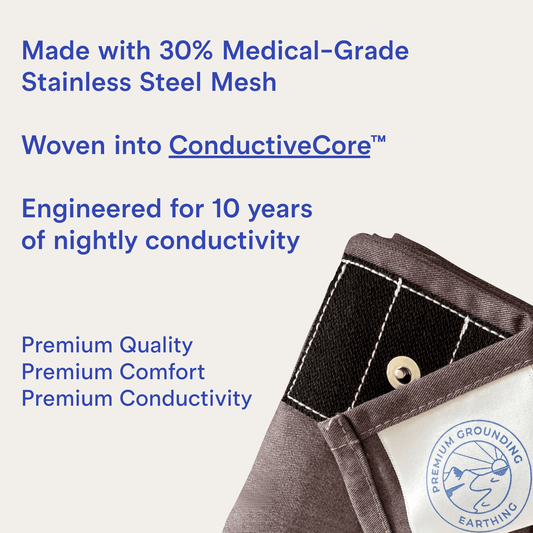
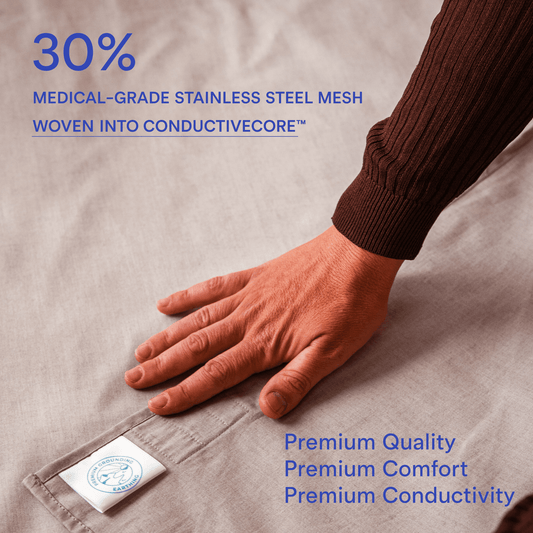
316L medical-grade stainless steel fibres. Tested conductivity. Built for nightly use over years, not months.
Shop the Grounding MatWhat Actually Matters in a Grounding Mat
Almost every grounding mat on the market looks similar in product photos. The differences only show up after you have used the mat for a few months — and by then, you have already paid for it. Here are the specifications that separate a mat that lasts five years from one that fails in five weeks.
1. Conductive material and thread density
The conductive material is the single most important spec. It determines whether the mat works on day one and whether it still works on day 1,000. The three materials you will see most often are stainless steel, carbon, and silver-coated fibres. We have a full breakdown of stainless steel vs silver vs carbon, but here is the short version:
Thread density also matters. A mat that uses scattered conductive fibres will perform worse than one with a tighter, more uniform weave, even if the materials are identical on paper. Look for product pages that name a specific stainless steel grade (316L is the medical-grade benchmark) rather than the generic phrase "conductive fibres."
2. Size and form factor matched to use case
A grounding mat is a tool. Like any tool, the right size depends on the job. Mats for bed use need to cover the area under your torso. Mats for desk use need to fit under your forearms or feet. Mats for pets need to be wipe-clean. Buying the wrong size is the most common reason customers feel underwhelmed in the first month — they bought a small mat and only got localised contact.
3. Cord length and ground plug compatibility
Every mat ships with a cord that connects to either a wall outlet's earth pin or a grounding rod. Cord length should reach from where you use the mat to the nearest grounded outlet without strain. We recommend at least 4.5 metres for bed use (most outlets are not next to the bedhead) and at least 3 metres for desk use. Some lower-cost mats ship with cords under 2 metres, which forces awkward setups or extension cords.
4. Continuity tester included
The fastest way to know whether a mat is still working is to test it with a continuity tester. Quality manufacturers include one in the box. If a brand does not include a tester and does not explain how to test grounding products at home, that is a signal they would rather you not check.
5. Washability
Mats that touch your skin nightly need to be cleanable. Stainless steel weaves can be hand-washed without losing conductivity. Carbon-rubber mats and silver-coated mats degrade with washing. Check the care instructions before you buy — if the mat is not washable, it has a much shorter useful life.
Grounding Mat Comparison Table: Specs Side by Side
Here is a like-for-like comparison of the four most common grounding mat formats sold today. We have stripped out brand names so you can apply this to whichever shortlist you are working from.
| Spec | Premium stainless steel mat | Standard carbon-leather mat | Silver-coated fabric mat | Budget conductive PVC mat |
|---|---|---|---|---|
| Conductive material | 316L stainless steel fibres | Carbon-impregnated rubber | Silver-coated nylon | Carbon-loaded PVC |
| Conductivity stability | Excellent — does not oxidise | Degrades unevenly with wear | Tarnishes from sweat and air | Hardens and cracks over time |
| Washable | Yes (hand wash, cool water) | Wipe only | Limited — accelerates tarnishing | Wipe only |
| Expected useful life | 3-5+ years of nightly use | 12-24 months | 6-12 months before noticeable loss | 6-18 months |
| Skin feel | Soft fabric, breathable | Rubbery, can feel sticky | Soft fabric | Plastic, non-breathable |
| Best for | Bed, desk, long-term use | Floor mats, occasional use | Light desktop use | Travel, low-budget trial |
| Continuity tester included | Yes | Sometimes | Rarely | No |
The takeaway: stainless steel mats cost more upfront but the cost-per-year is lower because they keep working long after carbon and silver alternatives have lost their conductivity. If you only plan to use a mat for a few weeks as a trial, a budget option is fine. For nightly grounding over years, stainless steel is the only material we would recommend.
Grounding Mat Picker: Match the Mat to the Use Case
The right mat depends entirely on when and where you want to ground. Use this picker to narrow your choice in under a minute.
Use case: Sleep (you want to ground 6-8 hours overnight)
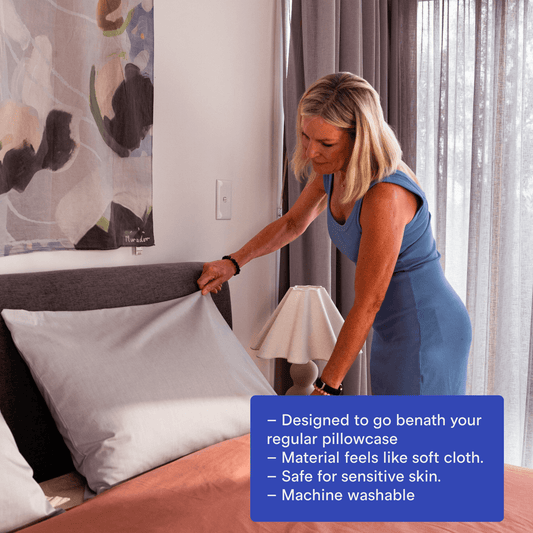
Best fit: A grounding sheet or a full-size bed mat. A sheet covers the entire mattress; a bed-sized mat covers the torso area only. Either works, and the choice comes down to whether you want to keep your existing bedding (mat) or replace your fitted sheet with a flat conductive sheet (sheet). For most people we recommend starting with a flat grounding sheet because the contact area is larger.
Why a mat over a sheet? If you share a bed and your partner does not want to ground, a single-side bed mat lets you ground without changing the sheets across the whole bed. We cover this trade-off in detail in our grounding sheet vs mat comparison.
Use case: Desk and computer work (you want to ground while working)
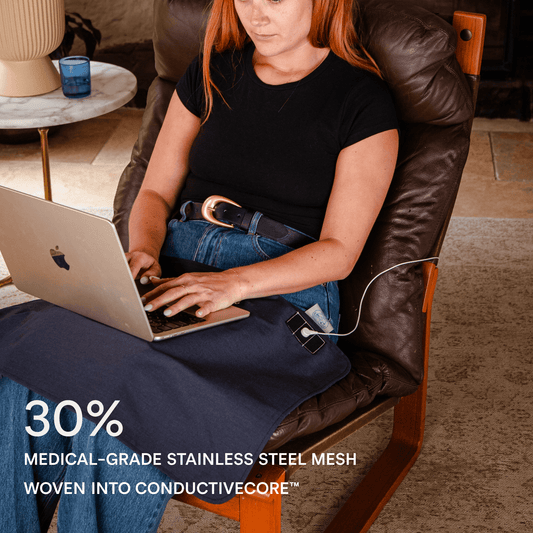
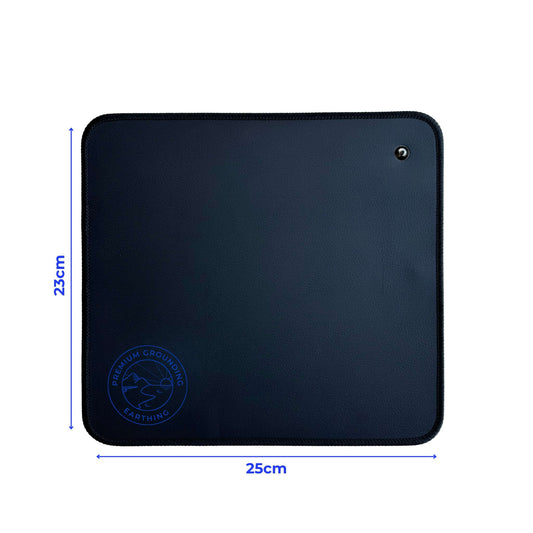
Best fit: A small mat under bare feet, or a desk pad your forearms rest on. Desk grounding is the second-most-common use case and is especially popular with people who spend 6+ hours a day at a screen. The mat does not need to be large — it just needs reliable skin contact for the duration of your work session.
Use case: Travel and hotel stays
Best fit: A compact, foldable mat in the 60 x 90 cm range. Look for one that rolls or folds without creasing the conductive layer. Stainless steel weaves handle folding well; rubber-based carbon mats can crack at fold lines.
Use case: Pets and kids
Best fit: A wipe-clean mat for pets (in case of accidents), and a soft fabric mat for children. We get regular questions about whether a grounding mat is safe for kids — yes, it is, and many of our customers ground their children's beds without issue.
Use case: Recovery after exercise
Best fit: A larger mat you can lie on, or a sheet on the bed. Grounding has been studied for its effect on delayed-onset muscle soreness (DOMS), with one pilot study showing reduced pain and improved recovery markers in grounded subjects (Brown, Chevalier, & Hill, 2015). Longer contact times during sleep produce the most consistent results.
How We Test Grounding Mats
Anyone can claim a mat is conductive. The question is whether the conductivity holds up over time and across the entire surface — not just at the corner where the cord attaches. Here is the test method we use on every product before it ships, and the same method you can use to check any mat at home.
Step 1: Continuity test from cord to mat surface
Set a multimeter to the lowest resistance range (200 ohms or less). Touch one probe to the snap or stud where the cord connects, and the other probe to a point on the mat surface at least 30 cm away. A working mat should read under 10 ohms. A mat reading 50 ohms or higher has either degraded or was poorly built from new.
Step 2: Surface uniformity check
Move the surface probe to four or five different points across the mat — corners, centre, near the cord. Resistance should be consistent across all points. Big swings (e.g. 5 ohms in one spot, 200 in another) indicate the conductive layer is patchy or is starting to fail.
Step 3: Outlet ground verification
The mat is only as grounded as the outlet you plug it into. Use a three-light outlet tester (under $15 at any hardware store) to confirm the wall outlet is properly earthed before you trust any continuity reading. We cover the full home-test protocol in our guide to testing grounding products.
Conductivity benchmark we hold our products to
| Test point | Pass | Borderline | Fail |
|---|---|---|---|
| Cord-to-surface (close) | Under 5 ohms | 5-15 ohms | Over 15 ohms |
| Cord-to-surface (far corner) | Under 10 ohms | 10-30 ohms | Over 30 ohms |
| Surface uniformity (variance) | Under 5 ohm spread | 5-20 ohm spread | Over 20 ohm spread |
If the mat you are considering does not have published conductivity data, ask the seller. A confident manufacturer will share it.
Common Mistakes That Make a Good Mat Underperform
Even a high-spec mat will disappoint if you set it up wrong. These are the issues we see most often when customers contact support feeling like the mat is not working.
Plugging into an ungrounded outlet
Older homes sometimes have outlets that look earthed but are not. If your three-light tester shows the wall is not properly grounded, the mat cannot conduct to earth — no matter how good the mat itself is. The fix is either to use a different outlet or to use an outdoor grounding rod with a grounding cord.
Sleeping fully clothed on top of a thick comforter
Grounding works best with bare skin in contact with the mat or with a thin cotton layer in between. Heavy bedding, synthetic fabrics, or thick pyjamas can reduce contact enough that you stop getting useful conductivity. We cover this in does grounding work through clothes.
Expecting results in three days
Most published studies on grounding measure outcomes after 4 to 8 weeks of consistent use. Cortisol normalisation, sleep architecture changes, and inflammation markers all take time to shift. If you are testing a mat for a week and seeing nothing, that is normal — give it the full month.
Not testing the mat after six months
Conductivity can degrade silently. Even premium mats benefit from a continuity check every few months. If the reading drifts, contact the manufacturer — most quality brands will replace under warranty.
Why Stainless Steel Wins on Specs
If we had to pick one specification that defines a quality grounding mat, it would be the conductive material. Stainless steel — specifically 316L medical-grade — outperforms every other common option on every metric that matters for long-term grounding:
This is why our mats and sheets use 316L stainless steel woven through the contact surface, rather than the cheaper carbon and silver alternatives that dominate the lower end of the market.
Built to the spec leader benchmark
316L medical-grade stainless steel. Continuity tester included. 120-night trial.
Shop the Grounding MatGrounding Mat vs Grounding Sheet: When to Choose Which
The single most common question we get from new customers is whether to start with a mat or a sheet. The decision tree is straightforward:
Many long-term customers end up with both — a sheet for nightly use and a mat for the desk. We have a side-by-side comparison guide if you want to dig further.
Frequently Asked Questions
What is the best grounding mat for a bed?
For bed use, look for a mat that covers at least the torso area, uses 316L stainless steel fibres, and ships with a cord long enough to reach a grounded outlet near the bed (4.5 metres or longer). For most sleepers, a flat grounding sheet covers more contact area and is the better starting point — but a mat works if you share a bed or want to keep your existing sheets.
How is a grounding mat different from a grounding sheet?
A grounding sheet replaces or layers under your bed sheet and covers the entire mattress. A grounding mat is a smaller piece of conductive fabric you can use on the bed, at a desk, or on the floor. Both work via the same principle — conductive contact with the Earth's electrical field — but mats are more flexible across use cases.
How long does a grounding mat last?
A well-built stainless steel mat should give 3 to 5 years of nightly use without measurable conductivity loss. Cheaper carbon, silver-coated, or PVC mats typically degrade within 6 to 24 months. The single best way to know is to test conductivity with a multimeter every few months.
How do I know if my grounding mat is working?
Use a multimeter on the lowest resistance setting. Touch one probe to the snap where the cord connects, and the other to the mat surface 30 cm away. A working mat reads under 10 ohms. Anything above 30 ohms indicates the mat or cord has degraded. Our full home-test protocol is in how to test grounding products.
Can I wash a grounding mat?
Stainless steel mats can be hand-washed in cool water with a mild detergent and air-dried. Avoid bleach, fabric softener, and machine washing. Carbon and silver mats should be wipe-cleaned only — washing accelerates their degradation.
What size grounding mat do I need?
For a desk, a 30 x 60 cm mat under the feet or wrists is sufficient. For a bed, choose a mat that covers at least the torso (typically 70 x 180 cm or larger), or use a full grounding sheet. For travel, look for a foldable mat in the 60 x 90 cm range.
Are stainless steel grounding mats better than silver?
Yes, on every long-term metric. Silver is more conductive at the moment of manufacture, but it tarnishes from sweat and air, often losing significant conductivity within 6 to 12 months. Stainless steel does not tarnish and holds conductivity for years. We cover the trade-off in detail in our stainless steel vs silver grounding products comparison.
Can children and pets use a grounding mat?
Yes. Grounding mats deliver no electrical current — they simply provide a conductive path to earth. Many of our customers ground their children's beds and place mats where pets rest. Choose a wipe-clean mat for pet areas in case of accidents.
How long should I use a grounding mat each day?
The longer the contact, the more reliable the effect. Most published studies use 6 to 8 hours of nightly contact during sleep. Daytime sessions of 1 to 4 hours at a desk add to the total but are less impactful than continuous overnight grounding.
Do I need a grounding rod or will a wall outlet work?
A properly earthed wall outlet works for the vast majority of homes. Confirm your outlet is earthed using a three-light outlet tester (under $15 at any hardware store). If your outlet is not earthed, or if you live in an older property with non-grounded wiring, a grounding rod connected via the outdoor cord is the alternative.
Final Checklist Before You Buy
Before you commit to any grounding mat, run through this five-point checklist:
If a mat ticks all five boxes, the spec sheet is doing its job. From there, the decision comes down to size and use case, both of which the picker section above should help with.
References
Related Articles
Premium Grounding Products
-
Premium Grounding Sheets
Regular price From $324.00 NZDRegular price -
Multi-Purpose Grounding Pad
Regular price From $207.00 NZDRegular price$272.00 NZDSale price From $207.00 NZDSale -
Premium Grounding Mat
Regular price $168.00 NZDRegular price$0.00 NZDSale price $168.00 NZD -
Earthing Grounding Pillowcase
Regular price From $149.00 NZDRegular price$0.00 NZDSale price From $149.00 NZD -
Earthing & Grounding Mat
Regular price From $127.00 NZDRegular price$0.00 NZDSale price From $127.00 NZD -
Pet Grounding Mat
Regular price $168.00 NZDRegular price$0.00 NZDSale price $168.00 NZD -
Grounding Mouse Pad
Regular price $103.00 NZDRegular price$0.00 NZDSale price $103.00 NZD -
Mulberry Silk Sleep Mask
Regular price $103.00 NZDRegular price