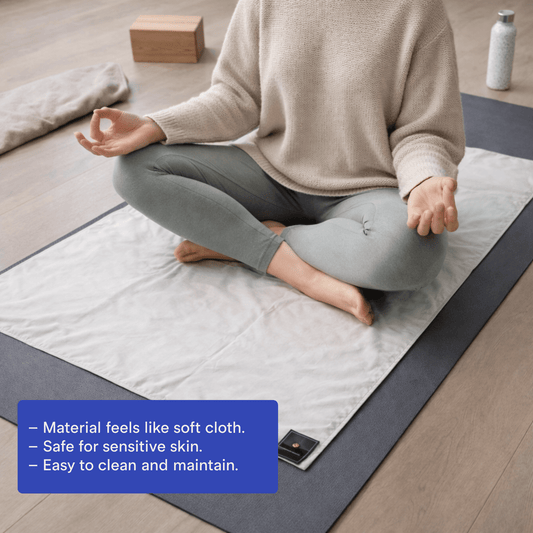
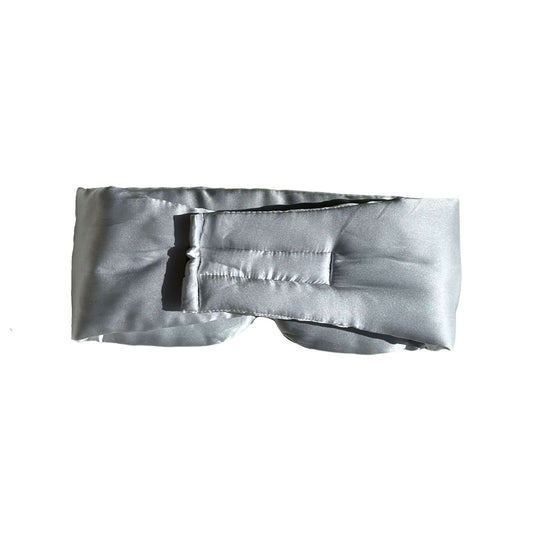
A grounding mat is a conductive pad — typically woven with stainless steel fibres — that connects you to the earth's natural electrical field through a standard wall outlet's ground port. Lie on it, sit on it, or rest your feet on it, and your body equalises to earth potential. The science is now backed by more than 20 peer-reviewed studies showing measurable effects on sleep, inflammation, cortisol, and recovery.
This is the complete buyer's guide and reference for grounding mats: how they work, what they do, how to choose the right one, and how to use it correctly.
A grounding mat (also called an earthing mat) is a flat conductive surface designed to transfer the earth's free electrons into your body. Modern mats use woven stainless steel — durable, hypoallergenic, and machine-washable — connected via a coiled cord to the ground pin of a wall outlet. The outlet's ground wire runs to a copper rod buried in the soil outside your home, completing the circuit.
When your skin contacts the mat, your body voltage drops to within millivolts of earth potential within seconds. This is the same physiological state you'd reach barefoot on wet grass — except you can do it indoors, in bed, at your desk, or under your feet while you work.
The mechanism is electrical, not chemical. Your body accumulates static charge from synthetic fabrics, electronics, and friction throughout the day. It also carries a low-grade positive charge from inflammatory free radicals — unpaired electrons looking to balance out.
The earth holds a virtually unlimited supply of free electrons. Connecting your body to it — directly via skin contact with soil, or indirectly via a grounded conductive surface — allows those electrons to flow in and neutralise the imbalance. Researchers call this "earthing" or "grounding."
A 2012 study published in the Journal of Inflammation Research demonstrated that grounding reduces inflammation markers within hours. A 2015 review in the Journal of Inflammation Research concluded that grounding "appears to be one of the simplest and yet most profound interventions for helping reduce cardiovascular risk and cardiovascular events."
The mat and the sheet do the same thing electrically. The difference is form factor and use case.
| Feature | Grounding Mat | Grounding Sheet |
|---|---|---|
| Best for | Desk, sofa, under feet, travel, focused sessions | All-night sleep, full-body coverage |
| Coverage area | Localised — feet, hands, or seated body | Full body across the bed |
| Daily use time | 1–4 hours actively | 6–8 hours passively while you sleep |
| Portability | Excellent — rolls up, fits in luggage | Stays on the bed |
| Skin contact required | Yes (bare feet or hands) | Yes (most body in contact while sleeping) |
Most users start with the mat because it's the easiest entry point — sit at your desk, kick off your shoes, and you're grounded. The sheet is the upgrade once you want eight hours a night of passive grounding without thinking about it. Many users own both.
Three things matter when buying a grounding mat. Get them right and the mat lasts years. Get them wrong and you'll be replacing it within months — or worse, using a mat that doesn't conduct properly in the first place.
The conductive fibre matters more than anything else. Stainless steel is the gold standard: fully conductive, hypoallergenic, doesn't tarnish, doesn't smell, and survives hundreds of wash cycles. Silver-coated mats are common in cheaper imports, but the silver coating degrades quickly with washing and sweat, and conductivity drops. Insist on stainless steel woven directly into the fabric.
Grounding mats come in sizes designed for different uses:
This is where most cheap mats fail. A mat is only as good as the connection it makes — and outlet wiring varies wildly between homes, regions, and ages of property. The two reliable verification tools are a grounding socket tester (confirms your outlet is correctly wired) and a grounding multimeter (confirms current is actually flowing into the mat). Both are sold separately and are worth every cent — buying a grounding mat without verifying it works is like buying a car you can't start.
Most people notice something within the first three nights — usually deeper sleep, less restlessness, or a calmer baseline mood. The bigger effects are cumulative:
Yes — for almost everyone. There is no electricity flowing through the mat. You're not being shocked, you're being equalised to the earth's natural electrical potential, which is what humans evolved to do barefoot.
The exceptions: if you have a pacemaker or implanted electrical medical device, talk to your cardiologist first. If you take blood-thinning medication (warfarin, etc.), grounding can mildly enhance circulation, so discuss with your doctor — some users have found their dose needed adjusting after starting.
Yes — there are now more than 20 peer-reviewed studies showing measurable physiological effects, from reduced inflammation to improved sleep architecture to faster recovery. The mechanism (electron transfer from earth to body) is well-established physics.
Direct skin contact is dramatically better. You can get partial conductivity through thin damp natural fibres, but for serious results, bare skin to mat is the rule.
Most users aim for 1–4 hours of active mat use during the day, plus a grounding sheet overnight if they want full coverage. Even 30 minutes a day is better than nothing.
Yes — provided your apartment outlet is properly grounded. Older buildings (pre-1970s) and some retrofit wiring may not be. A socket tester confirms it in two seconds.
You can, but a full grounding sheet is purpose-built for sleep — it covers the whole bed, stays in place, and gives you complete passive contact for the full 8 hours. A mat is better for active use during the day.
A well-made stainless steel grounding mat washed correctly should last 5+ years of daily use. Cheap silver-coated mats often fail within 6–12 months.
No — moisture actually improves conductivity. Just air-dry it after heavy use.
The Premium Grounding mat is woven from stainless steel fibres, machine-washable, comes with a coiled grounding cord, and is designed to last years. Pair it with a socket tester to verify your outlet, and you have a complete grounding setup that takes 90 seconds to install and works for years.